
Description
Describe the sound, the sensation, and the question that needs answering.
Sound-related difficulties can be hard to explain when fear, pain, loudness, and irritation get mixed together. Understanding Acousticophobia gives you a concise framework for keeping those details distinct and preparing a more useful conversation about care or everyday arrangements.
$5.00 · 12-page downloadable PDF · Two printable worksheets · Personal use
What you will find inside
- Recognize why fear of noise is not a complete explanation for every uncomfortable sound.
- Keep hearing-safety precautions separate from questions about fear or sensitivity.
- Organize a practical request for a meeting, event, workplace, or household.
You receive one carefully organized guide you can read offline, revisit before a conversation, and print selectively. The explanations and worked example lead into writing pages, so you can move from reading about the subject to recording the questions that matter to you.
Your 12-page guide, page by page
| Page | What you get |
|---|---|
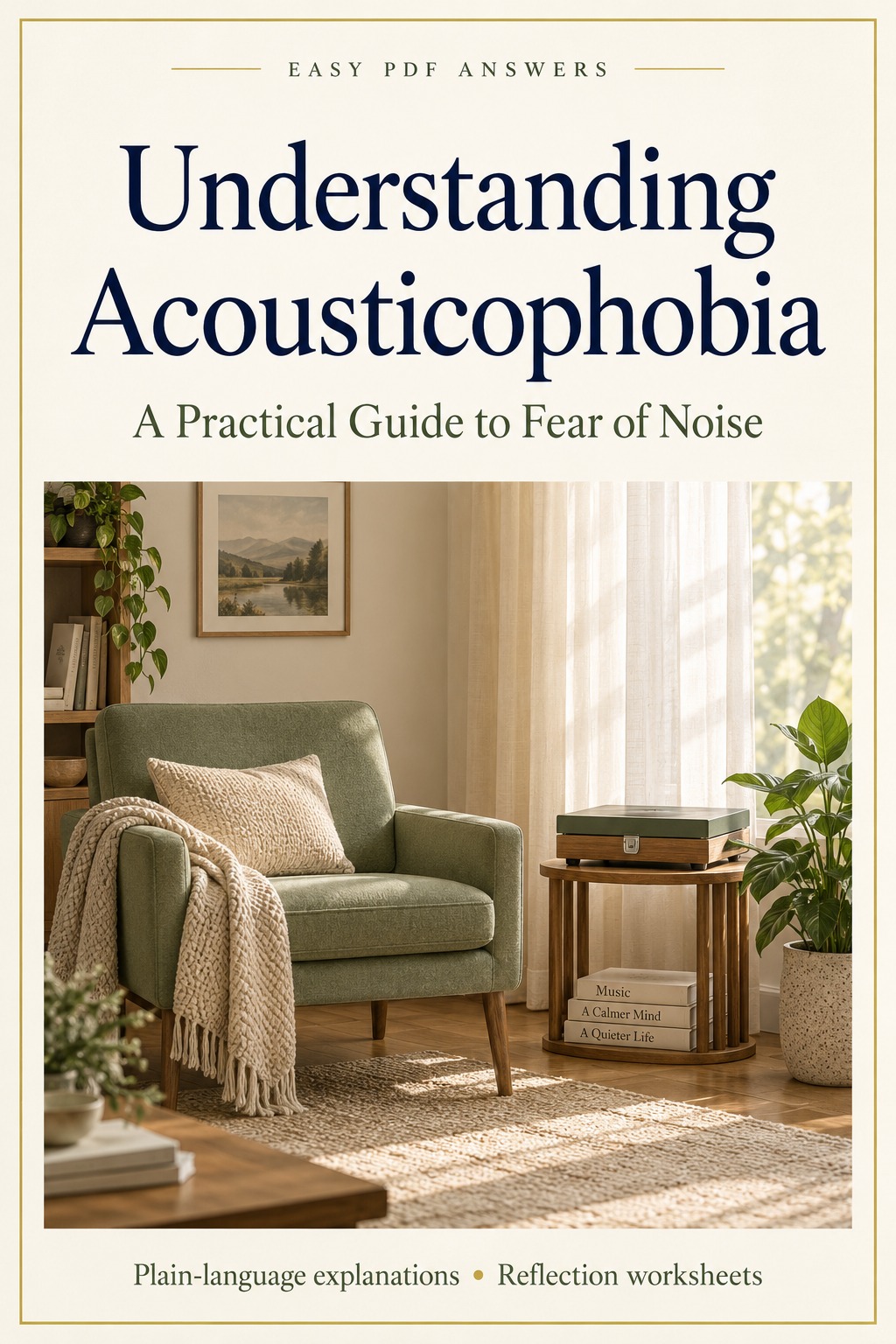
| 1 | Full-color cover matching the product image. |
| 2 | Read this before making changes Organize questions without testing your hearing. |
| 3 | Words that preserve the differences Fear, pain, loudness, and irritation carry different information. |
| 4 | Protection and symptoms Two questions that should not be confused. |
| 5 | Record the event, not a verdict A compact description for an assessment. |
| 6 | Communicate a practical request At home, at work, or before an event. |
| 7 | Ask how care will fit together Keep physical and emotional concerns visible. |
| 8 | Worked example: a community meeting An invented example of separating questions. |
| 9 | Use the pages as conversation aids Enough information, without constant monitoring. |
| 10 | One situation, clearly described Printable observation worksheet with five prompts and writing space. |
| 11 | My next useful conversation Printable question-and-action worksheet for your next discussion. |
| 12 | Sources and next steps Clickable links to free public references and a focused next-step prompt. |
Two worksheets you can actually use
The sound-event worksheet separates the setting, physical sensations, emotions, action, and effect on an activity. The conversation worksheet gives health questions and practical requests their own space, then records the response and follow-up.
These are print-and-write pages, not interactive PDF form fields or diagnostic tests. Use them once, print another personal-use copy when needed, or transfer a useful prompt into your own notebook. You can skip any question that does not fit.
A practical example included
The fictional community-meeting example shows a reader separating a microphone-related concern from ear discomfort and asking different people the relevant questions. It demonstrates communication, not a sound-tolerance exercise or an expected medical outcome.
Who this guide is for
An adult trying to describe sound-related fear, a reader with questions about which professional to ask, or someone preparing a clear practical request. Physical symptoms still need appropriate assessment.
Why choose the PDF?
The free companion articles provide longer discussions of individual questions. The paid PDF gives you a shorter, organized reference, an original worked example, brief reflection prompts, and two ready-to-print worksheets in one file. You are paying for that convenient format and original organization; the public source information remains freely available.
Format, delivery, and important details
- One 12-page PDF download; no physical item is shipped.
- Price: $5.00. The completed-order download provides the guide.
- Read with a standard PDF reader on a computer, tablet, or phone.
- Print the worksheets for your own use; resale and redistribution are not included.
- No subscription, course access, appointment, personalized assessment, or clinical service is included.
Prepared by Easy PDF Answers with AI assistance, September 22, 2026. This educational guide has not received independent clinical review. It does not diagnose a condition, prescribe treatment, or promise an outcome. The included examples are fictional. Seek qualified care for individual health concerns.
Explore the free companion articles
- Acousticophobia: Fear of Noise and What to Ask About
- A Sound Experience Diary: What to Record and What to Skip (Available from September 22, 2026, 6:04 p.m. Pacific.)
- Fear of Noise at Social Events: Make a Practical Plan (Available from September 22, 2026, 7:39 p.m. Pacific.)
- Discussing Noise Difficulties at Work (Available from September 22, 2026, 9:09 p.m. Pacific.)
- Sound-Related Fear: Choosing the Right Questions for Care (Available from September 22, 2026, 10:57 p.m. Pacific.)