

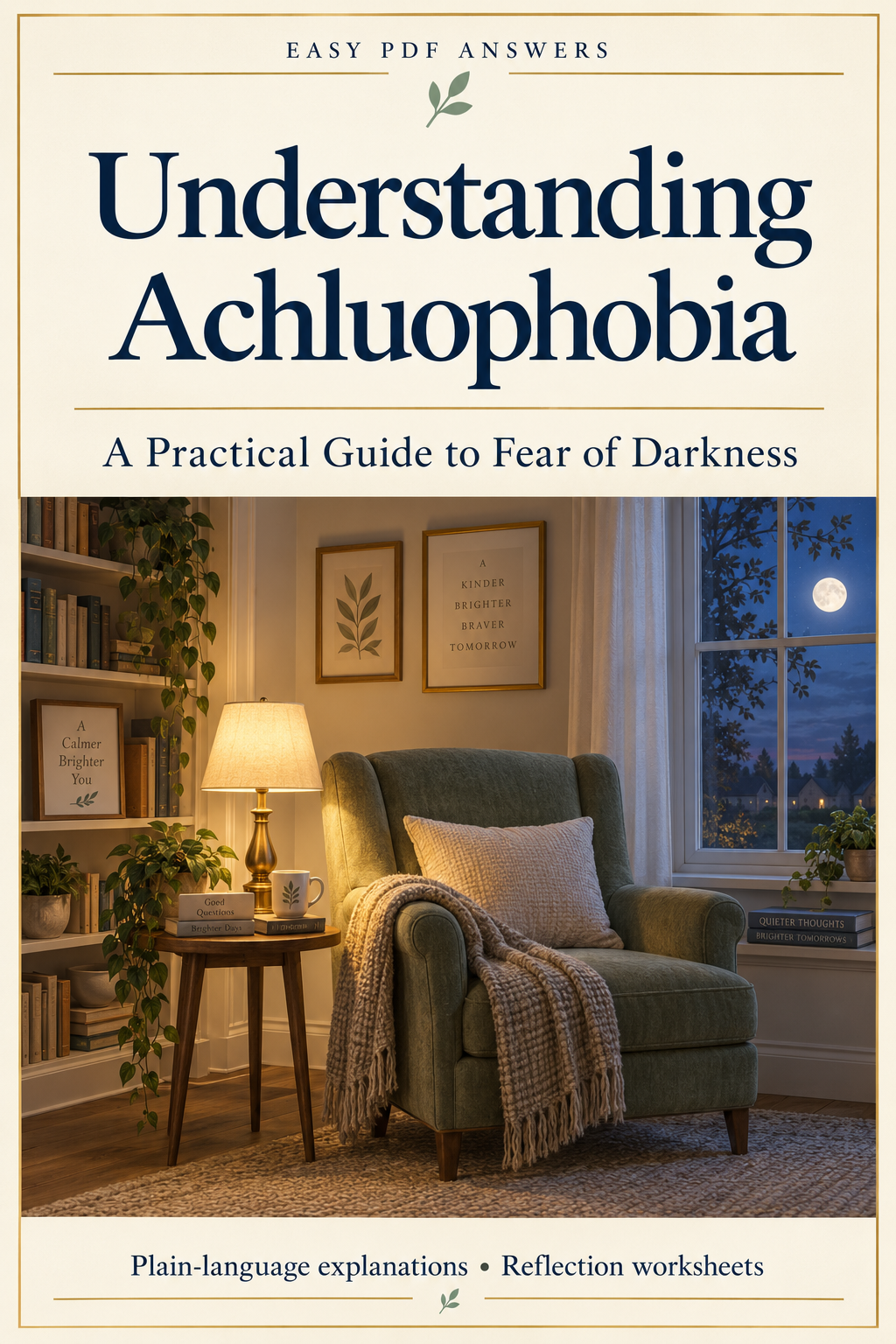
Achluophobia means fear of darkness. When that fear becomes intense, persistent, and disruptive, a clinician may assess it as a specific phobia. The useful starting point is describing what happens when light fades, what you expect might happen, and which parts of daily life the fear makes difficult.
A name can help, but your experience matters more
Finding a word for an uncomfortable experience can be a relief. It gives you something to search for and a way to begin a conversation. However, a term does not explain every person's nighttime difficulty. Someone may dread an unlit bedroom, while another feels comfortable sleeping but avoids walking through a dim hallway. Those are different situations, even when both people use the same label.
Fear of darkness is also discussed under the name nyctophobia. Cleveland Clinic describes that term in its patient information about intense fear of the dark. You do not need to settle the terminology before asking for help. Ordinary language such as “I delay going to bed because I become frightened when the room gets dark” can convey more useful information than a technical word alone.
This article focuses on recognizing and describing the problem. It does not offer a diagnostic quiz or ask you to prove anything by turning off the lights. If you already have a care plan, use your clinician's advice when deciding how to respond to difficult situations. A general explanation cannot account for your health, home environment, or personal history.
What makes darkness the focus of the fear?
Try to identify the moment when discomfort begins. It may happen as daylight fades, when another person leaves, when a lamp is switched off, or when you imagine an upcoming overnight stay. The timing helps distinguish the surroundings from the meaning attached to them. Darkness itself, being alone, uncertainty about a room, and memories associated with night are not interchangeable concerns.
You might notice a particular prediction: “I will not be able to see what is happening,” “I will become overwhelmed,” or “I will not know how to get help.” Write the prediction as a thought rather than a confirmed event. That small wording difference preserves accuracy. You are recording what your mind anticipates, not declaring that the anticipated event will occur.
It is equally useful to notice exceptions. Perhaps familiar rooms feel manageable, but unfamiliar accommodation does not. Perhaps the presence of another person changes the experience more than the brightness does. Exceptions do not invalidate the fear. They provide detail that may help a professional understand which aspect of the situation deserves attention.
Ordinary caution and a disruptive fear are different questions
Poor lighting can create genuine difficulties. A cluttered staircase, an unfamiliar outdoor route, or a missing handrail calls for practical safety measures. You do not have to dismiss these concerns to take fear seriously. Adequate lighting and a clear walking route are reasonable environmental decisions, not evidence that you have failed to be brave.
A different question is whether fear continues in circumstances that have been reasonably made safe and whether it substantially restricts your life. NIMH describes phobias in terms of intense fear, avoidance, and interference. A qualified professional considers the broader picture; a single preference for a bedside lamp does not establish a disorder.
For your own notes, separate “what needs fixing in the environment” from “what remains difficult after that is addressed.” For example, a loose hallway rug belongs on a household maintenance list. Spending hours dreading a familiar bedroom belongs in a conversation about your experience. Both observations can be valid without one canceling the other.
Look at the effect across a whole day
The most visible moment may happen at bedtime, but the consequences can begin much earlier. You might decline an evening invitation, spend the afternoon planning who will be home, or avoid booking a trip. These decisions are worth recording because they show the practical cost of the fear without requiring you to judge yourself.
Use specific descriptions rather than broad statements such as “night ruins everything.” “I left a family meal early twice this month because I wanted to arrive before sunset” tells a clearer story. “I waited for my partner to finish work before going upstairs” identifies a different effect. Neither example is a severity score; both are useful accounts of everyday functioning.
Also note what you would like to regain. A meaningful goal might be staying for an entire evening class, visiting relatives overnight, or having a less stressful bedtime. The goal need not be sleeping in complete darkness. A care discussion can start with the activities that matter to you rather than an externally imposed test of confidence.
Describe physical sensations without explaining them away
People can experience physical discomfort alongside fear, but unfamiliar symptoms should not automatically be attributed to anxiety. Describe the sensation, when it occurred, and whether it happens in other settings. “My heart felt fast after the light went out” is an observation. “My heart is healthy because this must be a phobia” is a conclusion that a personal journal cannot support.
If symptoms are new, severe, or concerning, seek appropriate medical advice. For ongoing nonurgent difficulties, bring a short account to a healthcare appointment. You can mention sleep disruption, medication changes, pain, or other relevant circumstances without deciding which one caused the fear. Let the clinician determine what assessment is appropriate.
Avoid repeatedly checking your body throughout the evening solely to create a perfect record. A brief note after an ordinary episode is enough for an initial conversation. The purpose of writing is to communicate clearly, not to turn every evening into a monitoring exercise or to make you responsible for diagnosing yourself.
A useful observation has four parts
Start with the setting: where you were, what the lighting was like, and whether you were alone. Then add the feared outcome in your own words. Next describe what you did, such as postponing bedtime or asking someone to stay. Finally, note the effect on an activity you wanted or needed to complete.
Here is a hypothetical example: “At 10 p.m. in my usual bedroom, I worried that I would panic once the hallway light was off. I stayed in the living room until midnight. I was tired during my morning meeting.” This account does not prove a diagnosis, but it gives a professional a sequence to discuss.
Keep the record short enough to use. Three recent examples with different settings may be more informative than pages of repeated descriptions. If you cannot remember an exact time, say “around bedtime.” If you are uncertain what you feared, write “unclear.” Honest gaps are better than filling the page with explanations that do not feel true.
Common assumptions that can make the conversation harder
One assumption is that adults should automatically be comfortable in the dark. That belief can make someone hide the problem until it has disrupted sleep or relationships. Age does not remove the need for a respectful assessment. You can ask for help without making a case that your fear is unusual enough to deserve attention.
Another assumption is that a single frightening childhood event must explain everything. Some people remember a relevant event; others do not. You do not need to invent a cause or search for a dramatic story. Start with what is happening now, then discuss your history if it becomes relevant during care.
A third assumption is that keeping a light on answers the entire question. Lighting may be a practical accommodation, but its meaning depends on the person and setting. Do not let anyone abruptly remove a support to test you. Decisions about changing patterns are better made with your agreement and, where needed, professional guidance.
What an initial request for help can sound like
You can keep the opening simple: “Fear around darkness is affecting my evenings, and I would like help understanding it.” Add one concrete effect, such as difficulty sleeping or avoiding necessary travel. This gives the appointment a clear purpose without requiring you to announce a diagnosis.
Ask whether the clinician can assess the concern directly or recommend someone with relevant experience. If sleep is a major difficulty, mention that separately. If a past event makes nighttime feel unsafe, you can say that history may be relevant without describing details before you are ready. You may also ask how information will be recorded and who can access it.
Practical access questions belong in the same conversation. Ask about costs, waiting times, appointment format, and what to do while waiting. If attending after dark is difficult, explain that when arranging the visit. A daytime appointment or remote option, where available and suitable, may make the first conversation easier to access.
Treatment information is a starting point for questions
Public health information describes psychological treatments for specific phobias, including cognitive behavioral approaches and exposure-based work. That does not mean you should design an intense challenge at home. The content, pace, and suitability of treatment depend on assessment and informed agreement.
Useful questions include: “What do you think is maintaining this difficulty?” “How would we decide on a goal?” and “How would you adapt the plan if sleep loss or another condition is involved?” These questions help you understand the reasoning behind care. They are more informative than asking for a universal number of sessions or a guaranteed date when fear will disappear.
Be cautious about programs promising an immediate cure or demanding that you tolerate overwhelming distress to prove commitment. A paid workbook, including ours, is an educational aid. It can organize your observations and questions, but it does not provide a clinician's assessment, supervised treatment, or a guaranteed outcome.
Questions people often have
Does using a night-light mean I have achluophobia?
No. A lighting preference alone is not a diagnosis. Consider the larger pattern: distress, restrictions, sleep disruption, and the reasons behind the preference. A person may use a light for navigation, caregiving, comfort, or several reasons at once. Describe your circumstances rather than comparing your room with someone else's.
Should I wait until the problem becomes severe?
You can request help when the difficulty is troubling you or limiting something important. There is no need to earn an appointment by reaching a crisis. Early conversations can clarify whether the main issue is fear, sleep, the environment, another health concern, or a combination that needs more than one kind of support.
What if I cannot explain exactly what scares me?
Begin with the sequence you can describe. “I feel distressed as the room becomes dark, but I cannot identify a specific thought” is useful information. You may understand the pattern better through conversation. Do not force an explanation simply because an online form asks for a neat answer.
Choose one clear next step
Before leaving this page, write a single sentence about the most important effect on your life. Then choose an action that matches it: arranging a healthcare conversation, discussing an evening routine with someone you trust, or gathering a few brief observations. You do not need to do all three today.
Keep your goal concrete and personal. Wanting a calmer bedtime, an easier visit with relatives, or less planning around sunset is enough to begin. Understanding fear of darkness starts with an accurate description of your experience and a suitable route to support, not with passing a test in a dark room.
For another part of this subject, read Fear of the Dark at Bedtime: A Practical Evening Plan. The complete reading list and availability times are below.
Sources and further reading
Sources checked September 22, 2026. References provide general background and do not endorse this article or the paid guide.
Explore the free companion articles
- Achluophobia: Understanding Fear of Darkness (You are reading this article.)
- Fear of the Dark at Bedtime: A Practical Evening Plan (Available from September 22, 2026, 5:27 p.m. Pacific.)
- How to Support Someone Who Fears the Dark (Available from September 22, 2026, 7:02 p.m. Pacific.)
- Fear of Darkness: Preparing for a First Appointment (Available from September 22, 2026, 8:48 p.m. Pacific.)
- Fear of Darkness Away from Home: Plan an Overnight Stay (Available from September 22, 2026, 10:14 p.m. Pacific.)
Browse more fear of darkness articles · Explore the phobia guides