


Phobia guides / Aeronausiphobia articles
If your main fear is being sick in front of other passengers, describe that social concern as well as any physical symptoms. Agree on discreet, practical support with a companion and ask the crew for help when needed. No one can promise others' reactions, but you can make your requests clear.
The worry may be less about aviation than about visibility: needing help, inconveniencing someone, or feeling unable to leave a shared cabin. Those details matter. This article focuses on communication and privacy, while keeping medical questions and persistent fear with the professionals qualified to assess them.
Name the part of the imagined event that troubles you
Try completing the sentence, “The part I am most worried about is…” Your answer might concern people looking at you, not knowing what to say, or needing assistance when movement is restricted. A specific answer helps you explain the concern without assuming that everyone understands what “I am afraid of being sick” means for you.
Do not treat the imagined reaction as an established fact. You may predict that everyone will judge you, but you cannot know each passenger's response in advance. A useful conversation distinguishes the prediction from an event that has actually happened. That leaves room to discuss the fear without arguing about a future scene nobody can verify.
Also note whether the same concern appears in other shared settings. If meals, public transport, or social events have become difficult, mention that broader pattern to a healthcare professional. The flight may be one example rather than the entire issue, and the assessment should not be narrowed unnecessarily by a travel-specific label.
Separate privacy preferences from medical needs
It is reasonable to prefer discretion about personal information. You can ask a companion not to announce your concern to other travelers or discuss your health casually. At the same time, obtaining appropriate help may require sharing relevant information with crew or medical personnel when you are unwell.
A useful agreement is: “Please keep the personal details private unless I need help, and let me speak where I can.” This preserves your role in the conversation while recognizing that safety and medical needs may change what should be shared. Avoid promising secrecy in a way that would obstruct necessary assistance.
Consider what a companion actually needs to know before travel. They may need your preferred way to ask for help or relevant instructions you want them to remember. They do not necessarily need every detail of your health history. Share deliberately, with the purpose of the information clear.
Give a companion one or two practical tasks
Support is easier when it is concrete. You might ask the person to help get the crew's attention, locate an item when movement is permitted, or avoid making jokes about the concern. Choose tasks that fit the journey and the companion's role rather than asking them to monitor every sensation.
Tell them what would not help. Repeatedly asking whether you feel nauseated, predicting that you will be fine, or describing other people's unpleasant flights may increase the focus on the feared event. You can request ordinary conversation or quiet company without claiming that either is a medical treatment.
A companion can be supportive without guaranteeing an outcome. “I can help you ask for assistance if you need it” is a promise about their action. “You definitely will not be sick” is a prediction they cannot control. The distinction makes support more honest and less dependent on certainty.
Prepare a short request for the crew
When you need assistance, use direct language about the current situation. “I am feeling unwell and need help” communicates more than an elaborate explanation of a rare phobia term. If you have a relevant medical issue or professional instructions, provide that information accurately when appropriate.
Follow cabin safety directions, including restrictions on standing or moving. Do not leave your seat against instructions because embarrassment makes you want to disappear from view. Ask the crew what assistance is available within the circumstances. Their procedures and immediate safety responsibilities affect what they can do.
You do not need to apologize at length before making a clear request. A concise statement allows the crew to understand the issue and respond. This article cannot predict the exact response on every flight, so avoid relying on a promise about a particular service or arrangement that the carrier has not confirmed.
Keep physical symptoms out of an embarrassment-only explanation
If you are nauseated or otherwise unwell, the symptom deserves appropriate attention even when embarrassment is prominent. The CDC explains that motion sickness can occur during air travel, but not every episode of nausea has the same cause. Do not assume a travel setting or a fear label settles the medical question.
Describe what is happening rather than minimizing it to avoid being noticed. If symptoms are severe, unusual, or concerning, seek appropriate assistance. A wish for privacy should not become a reason to withhold important information from someone helping with a medical situation.
After travel, discuss recurring symptoms with a healthcare professional. Include the social worry as part of the account, but do not let it replace the physical history. Both can matter, and a useful assessment can consider the relationship without requiring you to decide the cause yourself.
A fictional example: the fear is about being watched
Imagine Leah tells her partner that she is nervous about a flight. Her partner responds with facts about aircraft, but Leah realizes that aircraft safety is not her main concern. She is frightened of feeling ill while other passengers can see her and of not knowing how to ask for help.
Leah explains that distinction. They agree that her partner will avoid repeated symptom questions and will help get the crew's attention if she asks. Leah also plans to discuss the persistent anticipatory fear with a healthcare professional because it has begun affecting meals and other public settings.
The example does not promise that a conversation removes fear. It shows why specific wording matters: aviation reassurance was answering a different question. A practical support agreement and a professional discussion of the wider restriction address separate parts of the experience.
Avoid rehearsing the worst scene as preparation
There is a difference between preparing a short request and repeatedly imagining every detail of an embarrassing event. The first can support communication. The second may consume time without adding information about what you would actually do. If that pattern is troubling you, describe it in a care conversation.
You do not need to simulate vomiting, seek distressing footage, or deliberately provoke nausea to prepare for a flight. General information about phobia treatment does not make those activities appropriate self-help assignments. If a professional recommends treatment, ask how methods will be selected, explained, and agreed with you.
NIMH describes cognitive behavioral and exposure-based approaches among phobia treatments. That background should lead to informed questions, not an improvised program in the cabin. Ordinary travel and a planned therapeutic activity have different purposes and should not be silently substituted for one another.
Notice when the concern is changing eating or social life
Embarrassment-related fear can be important even before any physical event occurs. If you are skipping meals, avoiding visits, or spending long periods seeking reassurance, mention those changes. The effect on daily life is relevant, not merely whether the feared event has happened on an aircraft.
Do not create restrictive food or fluid rules as a way to avoid being seen unwell. Ask for appropriate professional advice if intake is affected. This article cannot supply a diet that guarantees a particular outcome, and online anecdotes should not become a substitute for care.
A useful statement is: “I am organizing more of my day around avoiding this possibility, and I want help with that.” It communicates the pattern without requiring a perfect diagnosis. You can ask how the assessment will consider both health symptoms and the fear of other people's reactions.
Decide how to respond to unhelpful comments
A friend may joke about travel sickness or repeatedly tell you to stop worrying. You can set a short boundary: “I know you may mean to help, but jokes about this are not useful. Please keep the conversation ordinary.” There is no need to debate every comment or provide a lengthy defense of the concern.
If a companion continues to pressure you, consider whether another support arrangement is more suitable. A supportive role should not involve humiliation, public disclosure, or surprise challenges. You can ask for respectful behavior while recognizing that another person cannot take responsibility for eliminating your fear.
For comments from strangers, prioritize the practical situation and appropriate assistance. You do not have to explain your health history to every passenger. If there is a problem requiring crew attention, use the appropriate channel rather than trying to resolve it through a public argument.
Review support after the journey in concrete terms
If you want to discuss the trip with your companion, focus on what they did that was useful and what you would like handled differently. “It helped when you asked one clear question and then gave me space” is more actionable than asking them to somehow make the next flight feel safe.
Keep the review separate from predictions about future travel. One journey does not establish exactly what will happen next time. If the worry remains consuming, bring that to a professional rather than repeatedly asking the companion to reinterpret the event until it feels certain.
You can record a small number of observations: the support request, the response, and the remaining care question. The purpose is to improve communication. It is not to reconstruct every passenger's expression or decide what everyone in the cabin must have thought.
If you write the request in advance, keep it brief enough to use when you are distracted. A few clear words about the present need can be more effective than a long explanation prepared for an imagined audience. You can add relevant details when the person helping asks.
Questions about embarrassment during flights
Must I tell nearby passengers about my fear?
There is no general requirement to disclose personal health concerns to other passengers. Share relevant information with those providing assistance when needed. A companion or crew member may be the appropriate person for a practical request; the whole cabin does not need your history.
What if reassurance never feels sufficient?
Tell a healthcare professional that repeated reassurance is not resolving the restriction and explain how much time the pattern takes. That is useful information for assessment. Another promise about the next flight may not answer the underlying question.
How can I prepare one useful conversation?
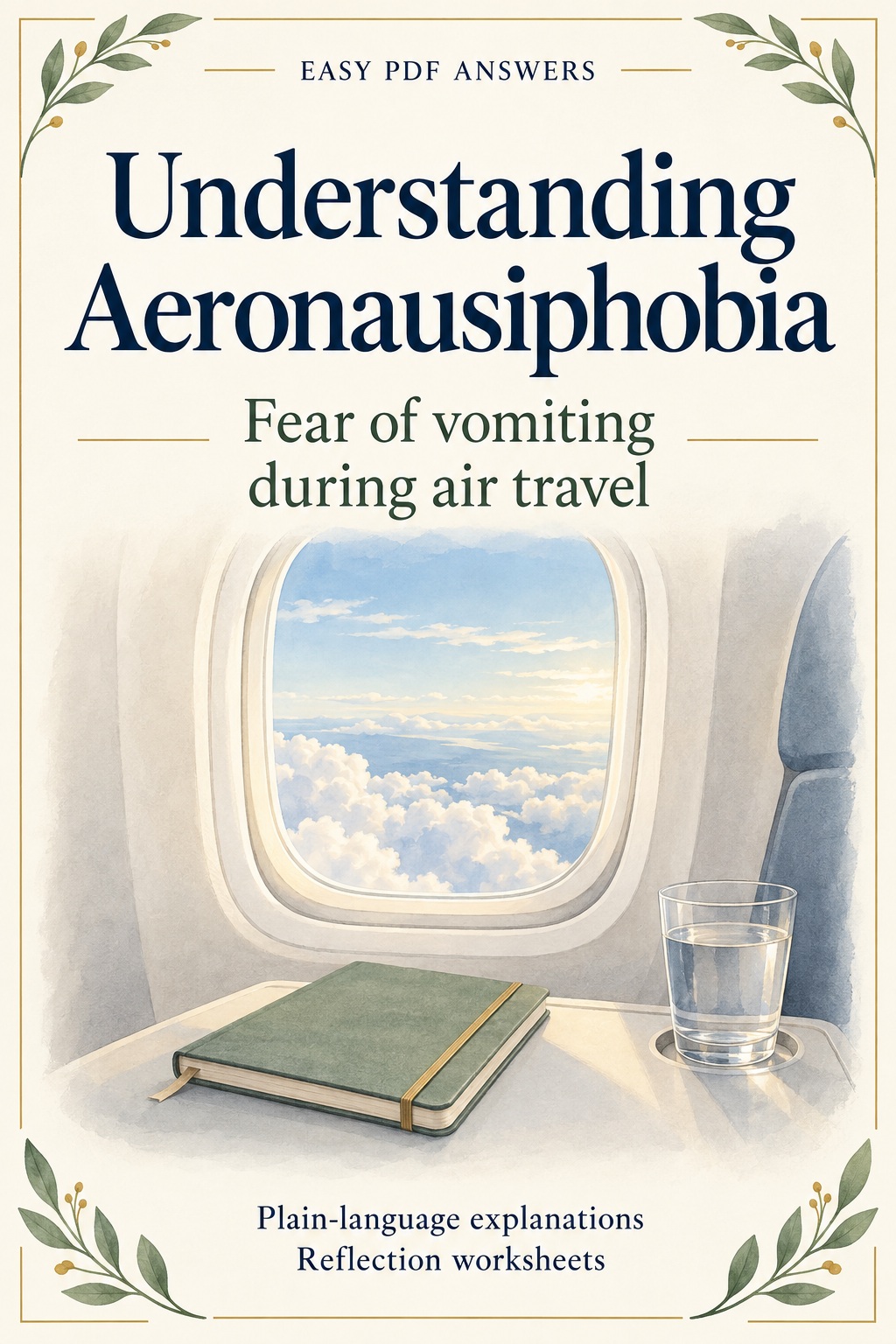
Write the feared social situation, the practical help you want, and the information you prefer to keep private. Understanding Aeronausiphobia includes two printable worksheets for organizing an account and a request within a 12-page guide. It also distinguishes symptoms from predictions and offers an original example, without promising how other people or your body will respond.
For another part of this subject, read After a Difficult Flight: What to Record and What to Ask. The complete reading list and availability times are below.
Sources and further reading
Sources checked September 22, 2026. References provide general background and do not endorse this article or the paid guide.
Explore the free companion articles
- Aeronausiphobia: Fear of Vomiting During a Flight (Available from September 23, 2026, 7:44 PM Pacific.)
- Before a Flight: Questions for a Pharmacist or Clinician (Available from September 24, 2026, 9:17 PM Pacific.)
- Packing for a Flight When You Worry About Feeling Sick (Available from September 25, 2026, 6:49 PM Pacific.)
- Worried About Being Sick in Front of Other Passengers? (You are reading this article.)
- After a Difficult Flight: What to Record and What to Ask (Available from September 27, 2026, 8:07 PM Pacific.)