


Phobia guides / Aeroacrophobia articles
Aeroacrophobia is an uncommon descriptive label for fear of open high places. It can be useful shorthand, but it does not establish a separate diagnosis. Describe the specific setting, what you experience, and how it affects an activity. Real fall hazards and physical symptoms still require appropriate attention.
A rooftop terrace may feel different from an enclosed room on the same floor. An open landing may trouble you when an elevator does not. Those differences are worth describing. This article helps you put the setting into words and identify useful questions without turning a visit into a test of courage.
Use the label carefully and describe the setting fully
The more familiar term acrophobia refers broadly to fear of heights; Cleveland Clinic discusses it in that general sense. Aeroacrophobia is used here to describe the open or exposed setting in your question. It should not be presented as proof of a distinct, independently confirmed condition with its own predictable course.
Start with the feature that matters to you. Is it an unobstructed view, a transparent barrier, a broad outdoor terrace, or the feeling of being far from an interior room? You may not know why one feature matters more than another. Recording the difference is still useful, because a general statement such as “I cannot do heights” may conceal important practical details.
Avoid building a rigid identity around one difficult event. You can describe what happened without deciding that every high place will be the same. Equally, being comfortable in one enclosed space does not invalidate difficulty elsewhere. A professional can consider the pattern with you rather than relying on the label alone.
Keep fear and ordinary fall prevention separate
High places can involve real hazards. Barriers, designated routes, posted restrictions, and staff instructions remain relevant whether or not someone feels anxious. No workbook should encourage leaning over an edge, climbing a railing, or entering a restricted area to prove that fear is unnecessary. An unsafe action does not become useful because it is described as confidence building.
Ask practical questions about the actual route and setting. Is the event indoors or outdoors? Does reaching it require an open staircase? Is the viewing area optional? These questions can clarify participation without requiring you to assess the engineering of a building. Technical safety questions belong with the responsible people and appropriate authorities.
Do not use your emotional reaction as a safety inspection. Feeling calm does not certify a place, and feeling frightened does not establish that a barrier is defective. If you notice a concrete hazard, report it. If you remain distressed in a setting managed for normal use, that distress can be discussed separately without dismissing ordinary precautions.
Notice what openness changes for you
Some people find that the visible space around them matters more than the floor number. You might be able to name a specific feature, such as seeing through a railing or standing in a wide outdoor area. Others may simply say that the setting feels exposed. Both descriptions are more informative than assuming that a height measurement explains the entire experience.
Try describing one setting in neutral terms: “The seating area was outdoors, with a glass barrier and a broad view.” Then add your experience: “I felt unable to move toward the table.” Keeping the scene and the response distinct helps someone understand what happened without treating your interpretation as a verified property of the place.
There is no need to visit another high setting to gather better examples. Use what you remember from an ordinary activity. If your memory is uncertain, say so. Preparation for a conversation should not require placing yourself in a situation that is unsafe or beyond what you have agreed with a treating professional.
Give physical sensations their own description
Dizziness, unsteadiness, or other bodily symptoms should not automatically be attributed to a phobia. NIDCD explains that balance problems can have different causes and warrant assessment. Describe the sensation in your own terms, including whether it occurs away from heights, rather than using a fear label to close the question.
You might say, “I felt unsteady on the terrace, and I have also noticed this in ordinary indoor settings.” That additional context may matter clinically. Avoid deciding on your own that the symptom proves a balance disorder or that it is definitely caused by anxiety. The point is to preserve the information for someone qualified to assess it.
If you become unwell in a high setting, prioritize safe assistance and follow staff instructions. Do not continue toward an edge to complete an exercise or prove a point. For severe or urgent symptoms, seek appropriate medical help. This article cannot assess a current episode or decide whether a planned activity is medically suitable for you.
Explain the activity you are missing
A useful care goal begins with everyday life. Perhaps you want to attend a family meal on a rooftop, use a building with an open lobby, or visit a viewpoint during a trip. Explain why that activity matters and which part of the setting creates difficulty. This is more concrete than a goal of never feeling fear again.
NIMH describes how persistent fear and avoidance can interfere with functioning. If your choices are becoming narrower, you can ask about support before deciding whether a formal diagnosis applies. Bring examples of the restriction, including plans you abandon, time spent negotiating arrangements, or events you leave early.
Keep the goal separate from a demand that you must complete a specific high-place activity immediately. A professional conversation can consider health, safety, preferences, and treatment options. Your value as a person is not measured by how close you stand to a railing or whether you join an optional viewpoint visit.
A fictional example: the birthday dinner upstairs
Imagine Hannah is invited to a birthday dinner described simply as “upstairs.” She later learns that the table is on an open rooftop terrace. She feels embarrassed about asking questions because she has used elevators in the same building before. She assumes that being comfortable inside means her terrace difficulty will seem inconsistent.
Hannah describes the difference directly: enclosed upper floors are manageable, while open terraces are difficult. She asks the host whether indoor seating is part of the event and what route guests use. Separately, she notes that similar settings have affected several recent plans and decides to discuss that recurring restriction with a healthcare professional.
This example is about accurate description and practical planning. It does not recommend a particular treatment or promise that an arrangement will remove fear. The useful shift is from defending whether the feeling makes sense to identifying the setting, the available options, and the question that needs professional input.
Ask about help without prescribing it to yourself
If treatment is discussed, ask how assessment will consider your specific experience and any physical symptoms. Ask what a proposed approach is intended to change, how consent is handled, and how progress would relate to the activities you value. General information about phobias can introduce possibilities, but it cannot select a program for an individual.
NIMH discusses cognitive behavioral therapy and exposure-based approaches among treatments for phobias. That does not make an internet list of height challenges a suitable personal plan. Do not improvise tasks involving balconies, ladders, roofs, cliffs, or unstable surfaces. Appropriate treatment planning must preserve real-world safety.
You can ask a professional to explain the difference between ordinary access arrangements and treatment goals. A temporary practical choice may be useful for an event, while a longer-term plan addresses the broader restriction. Knowing which conversation you are having can prevent a family outing from unexpectedly becoming a therapy exercise.
Give companions a clear role
A companion may want to help but not know how. Tell them whether you want assistance asking staff a question, company in an indoor part of the venue, or help remembering information. Do not assume that they understand the difference between an enclosed upper floor and an open high place simply because they know you dislike heights.
Agree that encouragement should not involve surprises, teasing, or physical pressure. A person should not pull you toward a view or change an agreed route to show you that it is fine. Practical support works better when it is discussed beforehand and remains consistent with safety instructions and your choices.
A companion also does not have to provide repeated guarantees about every possible outcome. They can help with a defined task while encouraging you to seek appropriate care for ongoing difficulty. This keeps the relationship from becoming organized entirely around checking and reassurance.
Make a short, useful record after an event
If reflection is helpful, record the activity, the setting feature, and the effect on participation. You might note that the route was different from the information supplied or that physical symptoms need follow-up. Keep the account factual rather than grading yourself as successful or unsuccessful based on whether fear appeared.
Do not repeatedly revisit photographs or seek out high-place videos merely to complete the record. The note is optional and should serve the next conversation. If reviewing the event becomes distressing or consuming, discuss that with a professional rather than assuming more detailed analysis is required.
A useful final line is a question: “What information should I ask the venue next time?” or “Should I discuss this unsteadiness with my clinician?” The question points toward an action. It avoids turning one event into a prediction about every future invitation.
When arranging help, you can send the short description in advance if the service accepts it. Ask whether photographs or venue details would be useful before collecting them. The professional may prefer a simple verbal account, and you do not need to assemble an elaborate file. Preparation should make communication easier, not become another barrier to making the appointment or attending an ordinary event.
Questions about open high places
Is this different from ordinary caution?
A label alone cannot draw that line for you. Consider the setting, actual hazards, and the impact on life, and seek assessment when fear is persistent or limiting. Appropriate fall prevention remains important regardless of whether anxiety is present.
Must I stand near a view to make progress?
No such requirement follows from this article. Do not create your own edge-related challenge. If you receive treatment, discuss goals and safe methods with the professional involved. Optional sightseeing is not a compulsory measure of health or character.
What does the guide add to this explanation?
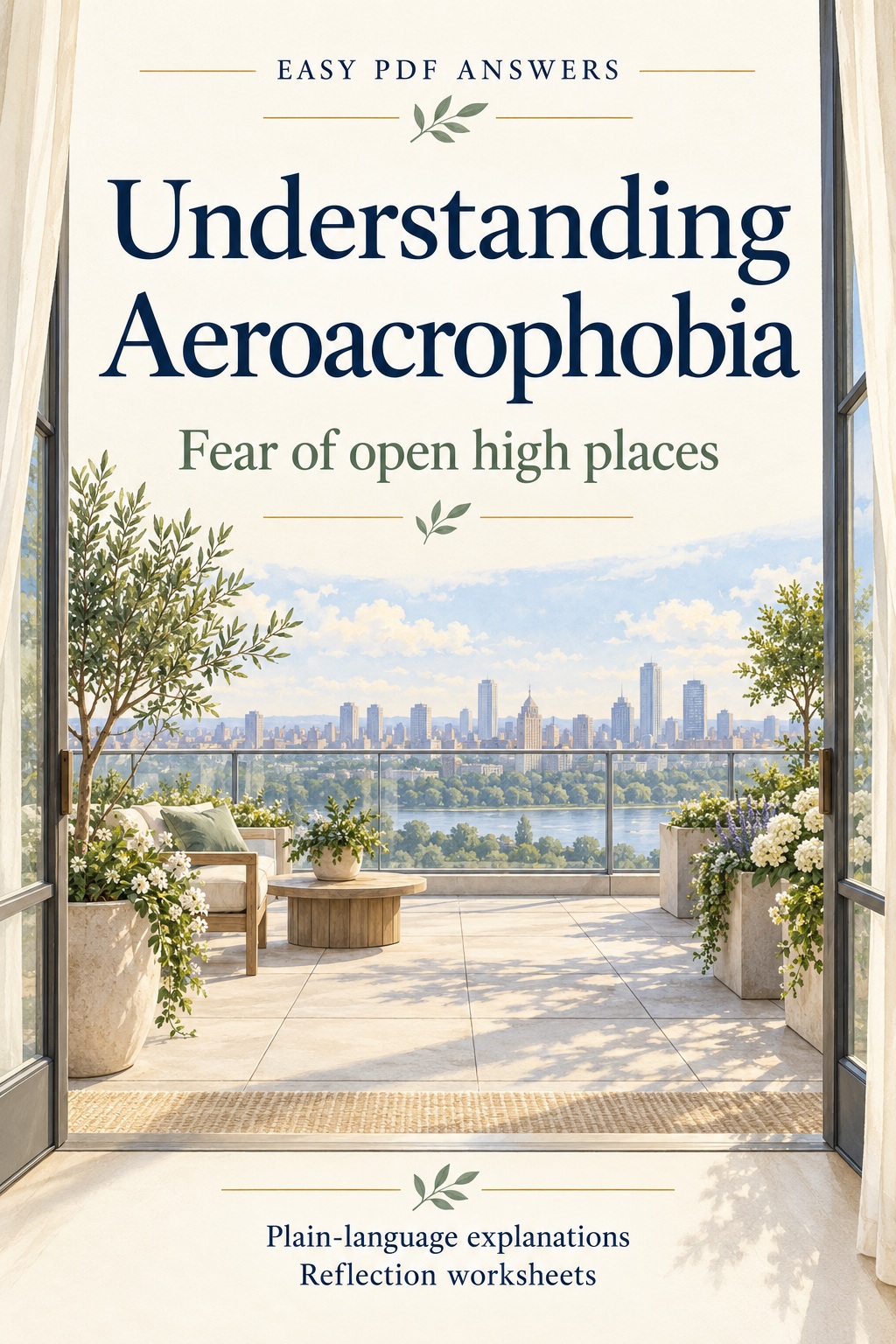
Understanding Aeroacrophobia provides 12 organized pages about describing exposed settings, keeping safety and symptoms distinct, and preparing practical conversations. It includes an original worked example and two print-and-write worksheets. Use the situation page for one event and the conversation page for a question you want answered; neither is a diagnostic test or an exposure plan.
For another part of this subject, read Viewing a Home When Balconies or Open Landings Worry You. The complete reading list and availability times are below.
Sources and further reading
Sources checked September 22, 2026. References provide general background and do not endorse this article or the paid guide.
Explore the free companion articles
- Aeroacrophobia: When Open High Places Feel Difficult (You are reading this article.)
- Viewing a Home When Balconies or Open Landings Worry You (Available from September 24, 2026, 12:50 PM Pacific.)
- Invited to a Rooftop Event? Questions to Ask Before You Reply (Available from September 25, 2026, 2:18 PM Pacific.)
- Open Stairs and Atriums: Asking About a Building Route (Available from September 26, 2026, 2:38 PM Pacific.)
- Planning a Family Outing with an Optional High Viewpoint (Available from September 27, 2026, 4:41 PM Pacific.)